 DarkOps
Complete guide
How to start a faceless YouTube channel with AI
What is a faceless YouTube channel
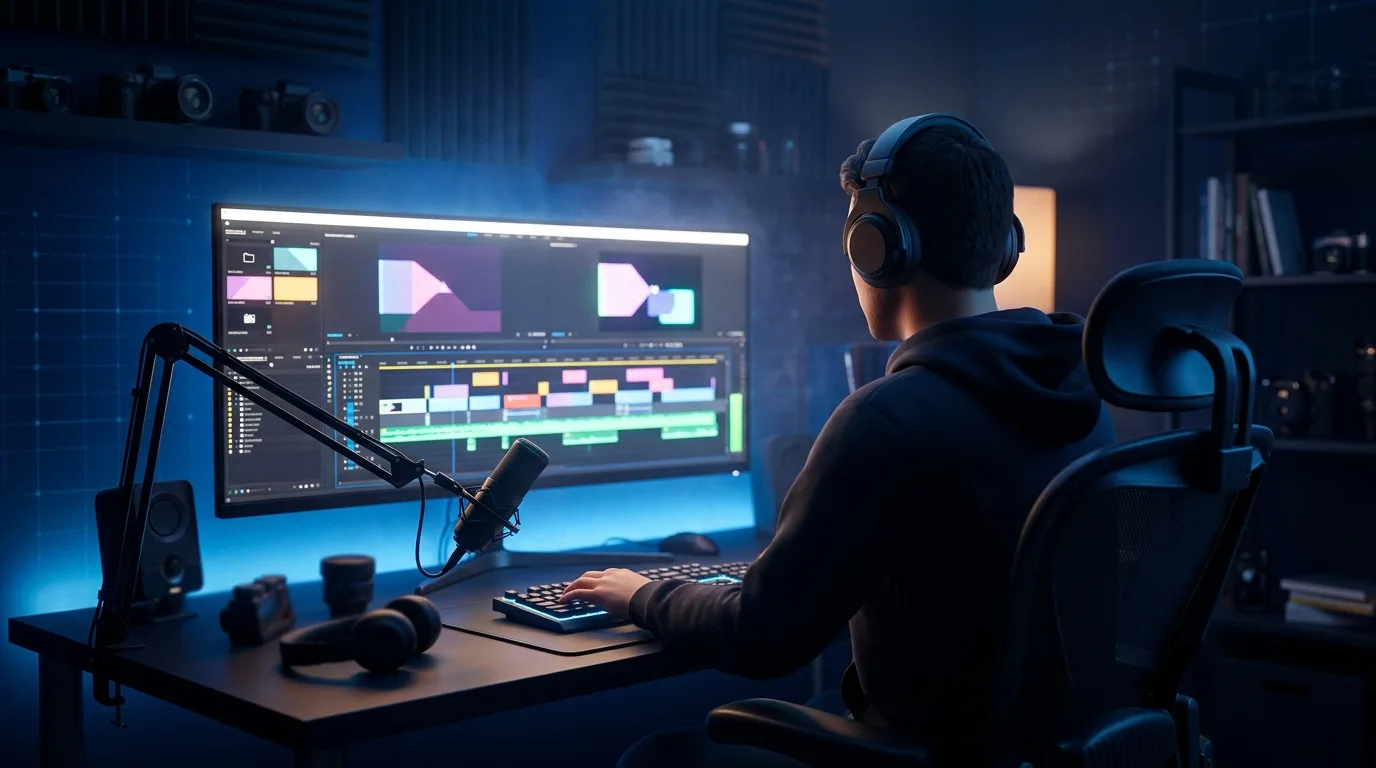
A faceless YouTube channel is one where the creator never appears on camera. Videos are built from voiceover, music, images, animation and editing, and what keeps people watching is the content itself: a well told story, a prayer, a fun fact, a study playlist. In Brazil, where DarkOps started, the same format is called a "canal dark".
The format took off because it separates the channel from the person. You can run more than one channel, in different niches, and AI now handles a lot of the grunt work. On YouTube alone, "faceless youtube channel" gets about 2.1 million searches a month worldwide (India 22%, US 15%, Pakistan 9%, UK 4%), and "ai faceless youtube channel" grew 24% in the last 30 days (vidIQ, estimated monthly YouTube searches, October 2026).
Can a faceless channel be monetized? YouTube's rules
Yes, as long as it follows the same rules as any other channel. To join the YouTube Partner Program you need 1,000 subscribers and 4,000 public watch hours in the last 12 months, or 1,000 subscribers and 10 million Shorts views in 90 days.
What sinks most faceless channels is something else. Since July 2025 YouTube calls mass produced or repetitive videos, nearly identical to each other and without real added value, inauthentic content. Channels like that are not monetized. Using AI is not banned: the problem is making the same video a hundred times and only changing the title.
Step 1: pick your niche with data
The most common mistake is choosing a niche because you like it. The right move is to cross two things: how many people search for the topic and how many channels compete for those searches. A niche with lots of demand and little competition is where a new channel has a shot.
In this Brazilian example, Bible stories and instrumental worship land in the sweet spot. Fun facts and lofi have huge demand, but competition is high too. The numbers for each niche and how to validate one are in the guide Faceless YouTube channel niches.
Step 2: find a reference channel and model it
Look for new channels (a few months old) that are already growing fast in the niche. A huge, old channel grows for reasons you can't repeat, like years of subscribers and recommendations. A new channel that blew up shows you a format that works today.
Modeling means pulling out what makes the channel work (format, length, pacing, title style, thumbnail style and upload frequency) and applying it to your channel with your own content. Copying videos, scripts or artwork is something else, and it leads to copyright and inauthentic content problems. The step by step is in How to reverse engineer a faceless channel.
Step 3: choose your format and frequency
- Shorts grow fast and let you test topics with little effort, but pay less per view.
- Long videos (8 minutes or more) build watch hours and usually earn more per view.
- Many channels use both: Shorts to attract, long videos to retain.
- Pick a frequency you can keep up for 3 months. Consistency matters more than volume in a single week.
Step 4: produce with quality
Every video goes through the same stages. By hand, that means jumping between six to eight different tools per video:
- 1TopicTheme and hook based on what already performs in the niche.
- 2ScriptA strong opening and the pacing of the format you picked.
- 3VoiceoverAI voice or your own cloned voice, with synced captions.
- 4MusicA track generated in your own AI music account, with a license.
- 5ScenesGenerated video or images (Flow, Veo) or stock footage.
- 6EditingAssembly, cuts, captions, logo and a subscribe call to action.
- 7PackagingTitle, thumbnail, description and tags.
- 8PublishingScheduled for the best time, with AI use disclosed.
What separates a channel that grows from one that stalls is the quality of three stages: the hook in the first 30 seconds, the voice (a robotic voiceover kills retention) and the thumbnail. Spend more time on those.
Step 5: packaging, title and thumbnail
The title and thumbnail decide whether the video gets clicked. Look at the best performing titles on your reference channel and notice the pattern: length, curiosity words, numbers. The thumbnail has to be readable on a phone, with three or four words at most.
Step 6: publish, measure and adjust
After 10 to 15 videos you have data. Check two numbers in YouTube Studio: retention (how much of the video people watch) and CTR (how many click when they see the thumbnail). Repeat what worked and change one thing at a time in what didn't.
How to do all of this in DarkOps
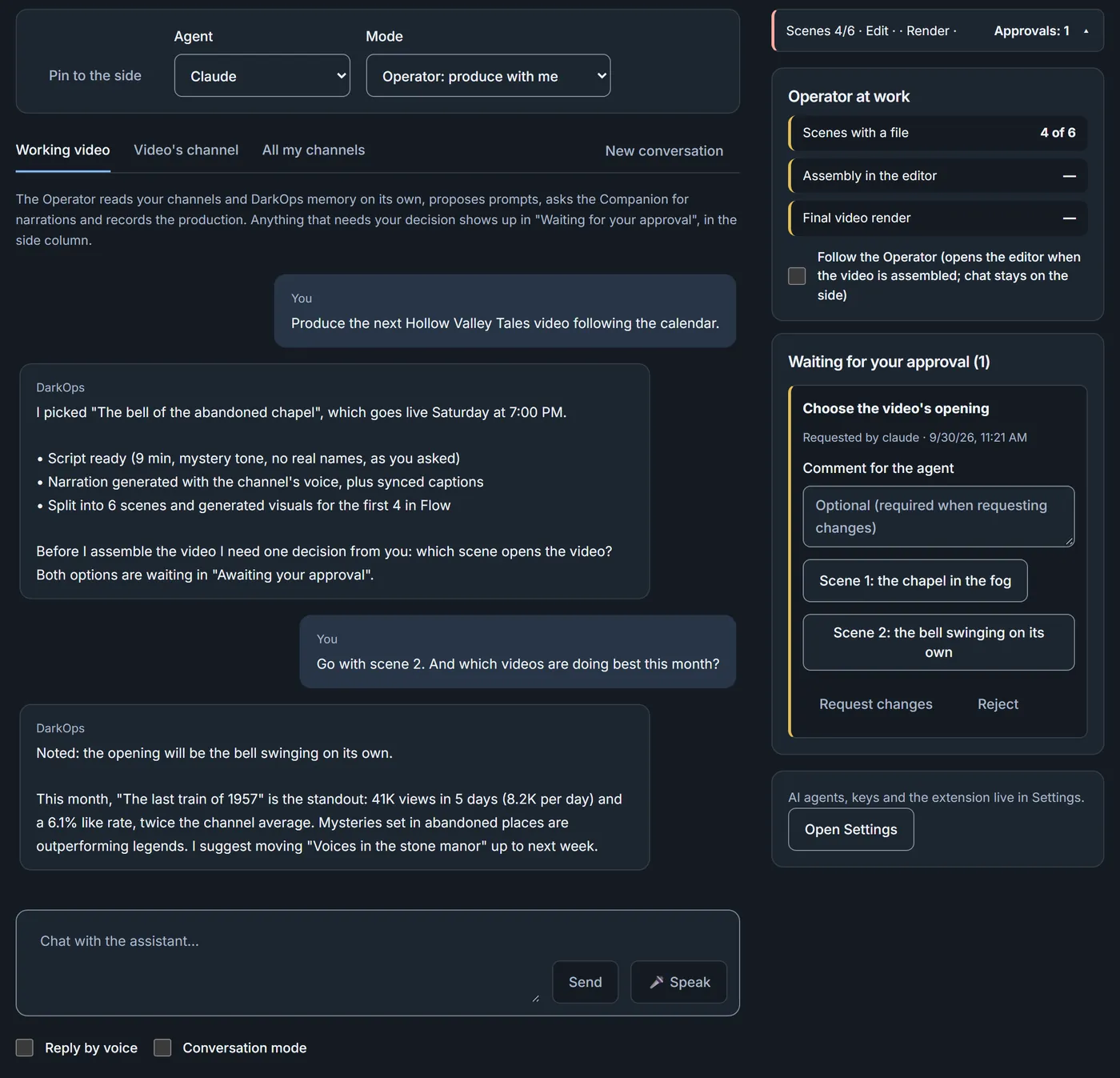
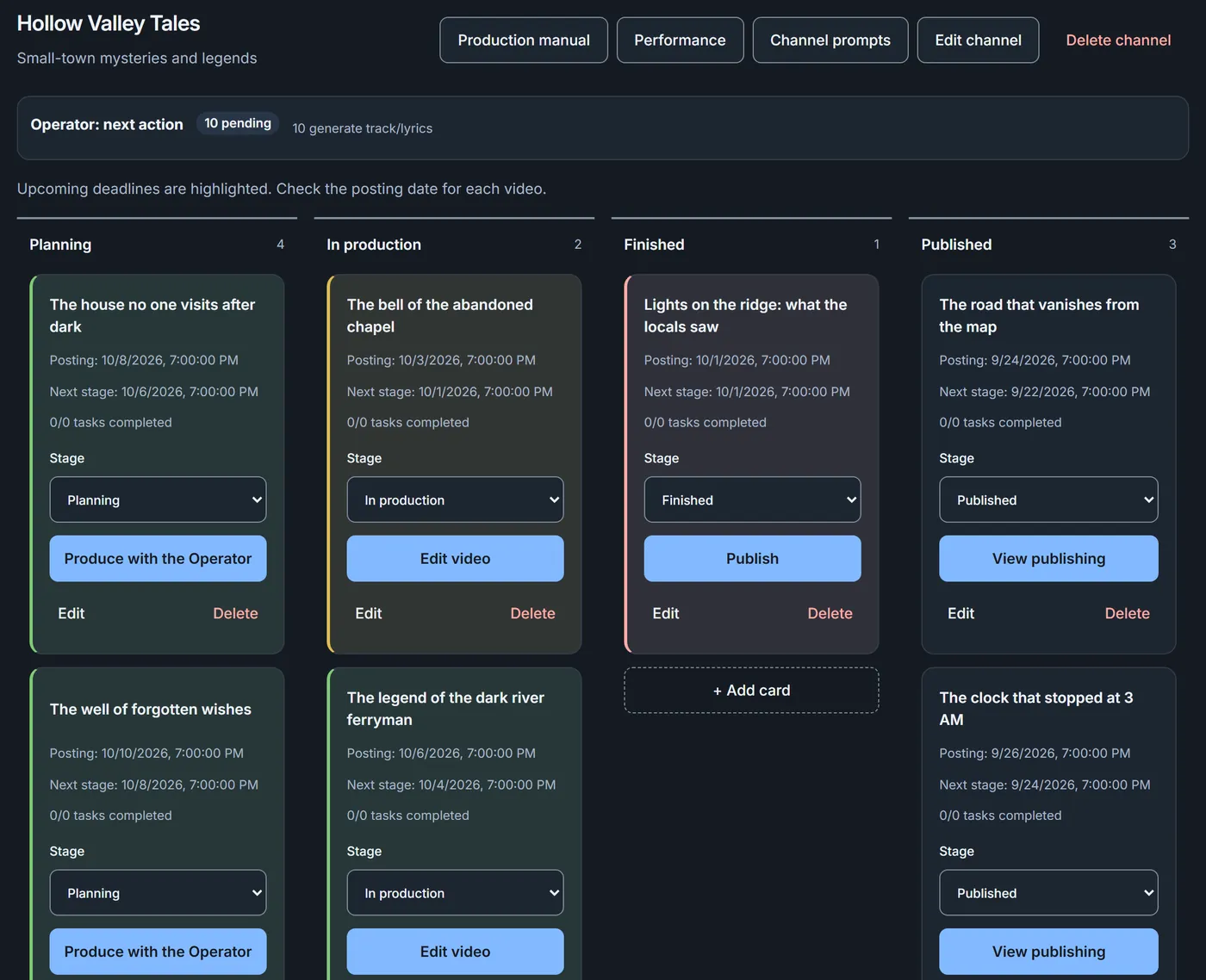
DarkOps was built for this process. The Operator, an AI agent, studies the niche numbers, models your reference channel and produces the script, voiceover, music, scenes and edit using your own AI accounts, with no markup from us on what they cost. You approve the key steps, and nothing is published without your permission.
Do it all in DarkOps
The Operator studies the niche, models your reference channel and produces the script, voiceover, music, scenes and edit with your own AI accounts. You just approve.
Try 7 days freeCancel before day 8 and you pay nothing.Frequently asked questions
How much does it cost to start a faceless YouTube channel?
You can start with free tools only, if you accept more manual work. With AI, the costs are whatever subscriptions you choose (a language model, an AI music tool, image or video generation). In DarkOps you use your own accounts, and the Corvo and Veludo voices are free.
Do I need to show my face or use my voice?
No. The voiceover can be done by AI. If you want a unique voice, you can clone your own from a short recording.
How long does it take a faceless channel to get monetized?
There is no guaranteed timeline. It depends on the niche, quality and consistency. What you can control is picking the niche well, modeling a format that already works and publishing regularly.
Are AI faceless channels banned on YouTube?
No. YouTube does not monetize mass produced or repetitive content, whether it was made with AI or not. Videos with an original script, careful editing and disclosed AI use are accepted.