 DarkOps
Practical guide
How to reverse engineer a faceless channel that already works, without copying
Modeling is not copying
- Reuploading or clipping another channel's videos
- Reading the same script with a different voice
- Using the same artwork and the same name
- Copyright and demonetization risk
- Repeating the format, length and pacing that work
- Covering the same kind of topic with your own script
- Following the title and thumbnail pattern with your own art
- A channel with its own identity and original content
YouTube rewards formats that hold attention. When a new channel grows fast, it has found a format the algorithm is recommending right now. Modeling (some creators call it reverse engineering) means learning that format and applying it to your own channel.
How to choose a reference channel
- Created less than a year ago and growing fast.
- In the same language and country you want to reach, or in a market the format hasn't reached yet.
- With videos you can produce at a similar level of quality.
- Avoid huge, old channels: they grow on their own base, and that can't be repeated.
What to take from the reference
| What to look at | Question to answer |
|---|---|
| Format | Is it narration over images, animation, music with a looping visual, a list? |
| Length | How long are the videos that grew the most? |
| Hook | What happens in the first 30 seconds? |
| Pacing | How often does the scene change? |
| Titles | Do they use a number, a question, a promise? How long are they? |
| Thumbnails | Colors, a face or an object, how many words? |
| Frequency | How many videos per week, and at what time? |
Separate spikes from evergreen videos
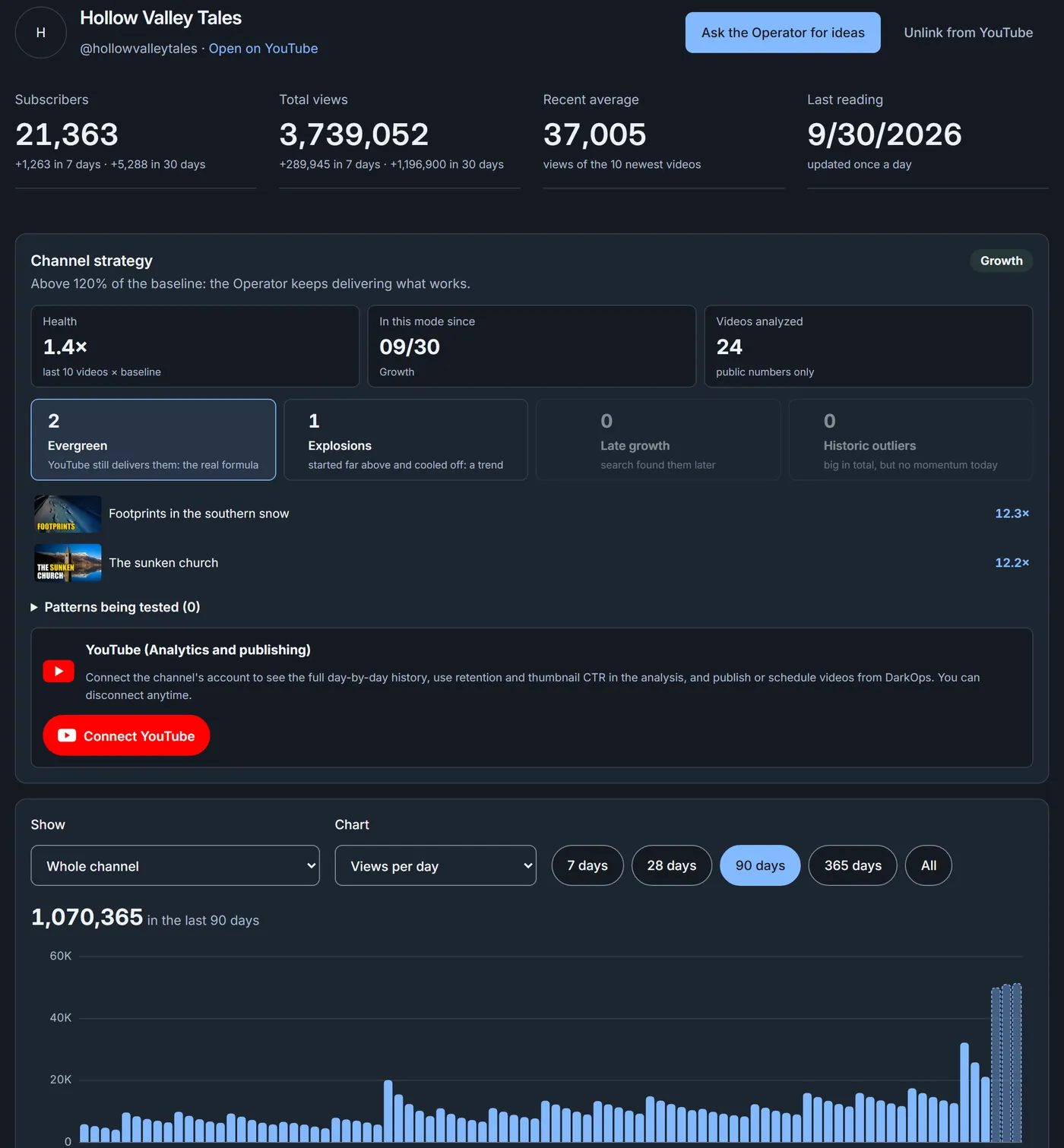
Take the 20 most recent videos. Spikes are the ones that got lots of views right away, pushed by recommendations. Evergreen videos keep getting views months later, pulled by search. A solid channel needs both: spikes bring subscribers and evergreen videos sustain the income.
What to change to have your own identity
- Your own name, logo and color palette.
- A different narration voice.
- Your own topic angle within the niche.
- A signature: an intro sting, a character, a catchphrase at the end.
Modeling in DarkOps
In DarkOps you pick the reference channel and the Operator extracts its format, pacing, thumbnails and frequency. Then it builds your channel to the same pattern, whether it is new or one you already have, and tracks the numbers to adjust.
Do it all in DarkOps
The Operator studies the niche, models your reference channel and produces the script, voiceover, music, scenes and edit with your own AI accounts. You just approve.
Try 7 days freeCancel before day 8 and you pay nothing.Frequently asked questions
Is modeling a channel allowed?
Yes. Nobody owns a format, a video length or a title style. What you can't do is reuse another channel's content, script or artwork.
How many reference channels should I use?
One main channel for the format and two or three secondary ones for topic ideas. Mixing too many dilutes the pattern.
What if the reference channel stops growing?
It happens. That's why you should track your own numbers after 10 to 15 videos and follow what works on your channel.